Friday, March 6, 2015

Octavio Paz: "Friendship"


It is the awaited hour
Over the table falls
Interminably
The lamp’s spread hair
Night turns the window to immensity
There is no one here
Presence without name surrounds me


"Friendship" by Octavio Paz, from Configurations (New Directions, 1971).

Art credit: "Leave the Light on," photograph by Peter Baker.

Thursday, March 5, 2015

Eileen Moeller: "Dear Ezra"


I have to confess:
there are abstractions
I no longer go in fear of.

Take loneliness.
I've started calling it solitude.
It feels so new and improved now,
I can honestly say it soaks up time
better than a sponge soaks up water.

The other day I actually washed this poem with it.

Ez, let me tell you,
aging is a Laundromat,
and eventually you find yourself
watching what you spurned
and dreaded for years
spread out in widening gyres,
like sheets fluffed in the dryer.

Life is quite a bit cozier
when you let all the bugaboos—
you know—say, sadness and fear
crawl into bed with you.

Pace them with your breathing
and they fall asleep
fast as a couple of kids.

The other night we huddled together
staring at the moon
as it slid past my window:
big-bellied sail on a wet black sea.


"Dear Ezra" by Eileen Moeller. Text as published in Poems of Awakening: An International Anthology of Spiritual Poetry, edited by Betsy Small (Outskirts Press, 2011). It was also published on And So I Sing: Poems and Iconography, the poet's blog. Reprinted here by permission of the poet.

Art credit: "Remedios folds a sheet at the laundromat on 47th Street," photograph by Jon Lowenstein, part of a series entitled "From Guerrero to Gringolandia and Back: Day Labor, Family, the New Global Economy."


Wednesday, March 4, 2015

Arlene Gay Levine: "Each Moment"


Behind the mask of summer sun,
the green rush of spring,
the peace of winter’s silence,
and autumn’s fiery crown
there are only moments strung together.
Beads on a chain,
each as valued as the next;
a necklace fashioned
of attention to this day.
What is gone
and what will be
are links fingered lightly
while we chant
the only word we know:
now, the glue
of our daily round,
the shining center
from where we came,
to which we shall return.


"Each Moment" by Arlene Gay Levine, published in Unity Magazine (May, 1999) and Movie Life: Poems (Finishing Line Press, 2011). © Arlene Gay Levine. Reprinted by permission of the poet.

Art credit: "As Above So Below," photograph by Tim Gainey.


Tuesday, March 3, 2015

Ted Kooser: "A Blind Woman"


She had turned her face up into
a rain of light, and came on smiling.

The light trickled down her forehead   
and into her eyes. It ran down

into the neck of her sweatshirt
and wet the white tops of her breasts.

Her brown shoes splashed on
into the light. The moment was like

a circus wagon rolling before her
through puddles of light, a cage on wheels,

and she walked fast behind it,   
exuberant, curious, pushing her cane

through the bars, poking and prodding,   
while the world cowered back in a corner.


"A Blind Woman" by Ted Kooser, from Weather Central (University of Pittsburgh Press, 1994).

Art credit: "Light in the Dark," photograph by BlackStripeTH17.


Monday, March 2, 2015

Emily Dickinson: "#690" ["Forever — is composed of Nows — "]


Forever — is composed of Nows —
'Tis not a different time —
Except for Infiniteness —
And Latitude of Home —

From this — experienced Here —
Remove the Dates — to These —
Let Months dissolve in further Months —
And Years — exhale in Years —
 
Without Debate — or Pause —
Or Celebrated Days —
No different Our Years would be
From Anno Domini's —


"#690" ["Forever — is composed of Nows — "] by Emily Dickinson, from The Poems of Emily Dickinson, edited by R. W. Franklin (Harvard University Press, 1999). This edition appears to be out of print.

Art credit: "Indra's pearls — Water droplets in a spider web 1," photograph taken on November 2, 2013 by Marjan Smeijsters.


Sunday, March 1, 2015

Barry Spacks: "What Breathes Us"


                                 Regards to the day, the great long day
                                 that can't be hoarded, good or ill.

                                 What breathes us likely means us well.


                                 We rise up from an earthly root
                                 to seek the blossom of the heart.

                                 What breathes us likely means us well.


                                 We are a voice impelled to tell
                                 where the joining of sound and silence is.

                                 We are the tides, and their witnesses.

                                 What breathes us likely means us well.


"What Breathes Us" by Barry Spacks. Text as published on CrossConnect (Volume II, Issue I, 1996). Listen to the poet read his poem.

My thanks to Teddy Macker for suggesting this poem for the collection.

Art credit: "Ocean Tides," image by unknown photographer.


Saturday, February 28, 2015

Linda Nemec Foster: "Eliminating the Horizon"


                                           —for Tom Andrews
                                                                                                                                                                                                           
Who needs boundaries?
If your eyes fail to imagine
where the earth ends and the sky
begins, think of a place bereft
of lines:  the blue depths of a stream
flowing like hair that will never
be combed.  Deep indigo of nothing
but fluid memory ebbing around
blossoms of white asters.  “I remember           
how flowers feel when you barely
touch them,” says the water.  Like leaving
one world and embracing another:
seeds bursting into wildflowers,
clouds changing into rain,
the image of our borders
a mere outline the soul ignores.


"Eliminating the Horizon" by Linda Nemec Foster, from Talking Diamonds (New Issues Press, 2009). © Linda Nemec Foster. Presented here by poet submission.

Art credit: "Le Double," photograph by Jean Moral. 


Friday, February 27, 2015

Dick Allen: "You May Leave a Memory, or You Can Be Feted by Crows"


Three years, Huang Gongwang
worked on his famous handscroll,
Dwelling in the Fuchun Mountains.

As he put successive applications of ink to paper
over the “one burst of creation,” his original design,
it is said he often sang like a tree frog
and danced on his old bare feet.

One day, he adds one hemp fiber stroke,
the next a moss dot.

What patience he had,
like a cat who comes back season after season to a mole’s tunnel.

Honors may go to others.
Riches may go to others.
Huang Gongwang has one great job to do.

And he sings like a tree frog,
and he dances on old bare feet.


"You May Leave a Memory, or You Can Be Feted by Crows" by Dick Allen. Text as published in Poetry (December, 2011). Reprinted by permission of the poet. Allen's most recent book is This Shadowy Place: Poems.

Art credit: Detail of "Dwelling in the Fuchun Mountains," scroll painting completed 1347-1350 C.E., by Huang Gongwang.


Thursday, February 26, 2015

Robyn Sarah: "An Early Start in Midwinter"


The freeze is on. At six a scattering
of sickly lights shine pale in kitchen windows.
Thermostats are adjusted. Furnaces
blast on with a whoosh. And day
rumbles up out of cellars to the tune
of bacon spitting in a greasy pan.

Scrape your nail along the window-pane,
shave off a curl of frost. Or press your thumb
against the film of white to melt an eye
onto the fire escape. All night
pipes ticked and grumbled like sore bones.
The tap runs rust over your chapped hands.

Sweep last night's toast-crumbs off the tablecloth.
Puncture your egg-yolk with a prong of fork
so gold runs over the white. And sip
your coffee scalding hot. The radio
says you are out ahead, with time to spare.
Your clothes are waiting folded on the chair.

This is your hour to dream. The radio
says that the freeze is on, and may go on
weeks without end. You barely hear the warning.
Dreaming of orange and red, the hot-tongued flowers
that winter sunrise mimics, you go out
in the dark. And zero floats you into morning.


"An Early Start in Midwinter" by Robyn Sarah, from The Touchstone: Poems New & Selected (House of Anansi, 1992). © Robyn Sarah. Reprinted with permission of the poet. Robyn Sarah’s new poetry collection, My Shoes Are Killing Me, will be published in April 2015 by Biblioasis Press. Biblioasis also published her 2009 collection, Pause for Breath.  

Poet photograph credit: D. R. Cowles.

Art credit: "Sunrise Through Window Frost," described as a "scan from an early 1980s Kodachrome 25 slide," by Rob Fillion.


Wednesday, February 25, 2015

Judith Heron: "Simple Instructions"


My teacher today, unexpectedly, is the repairman
at the vacuum cleaner shop. I go in for replacement bags
for my old Kenmore. He wants to see my machine,
to know if he can repair the broken hose. He laughs
when I tell him I have been using duct tape, asks me
if I understand what vacuum means. Tells me even
a pin-prick can reduce the function. Says he used to place
the hose in his pocket and run it like that to show people
the wasted effort of using old equipment. But you can
push it around that way if you want to. He smiles.

There will be many stories. His son is an engineer.
Works hard. Is prone to grumble. He teaches him
about the fruitless use of being sad. How people do not
want to be around you. How loneliness then creeps in.
Tells him, no matter what must be done, do it smilingly.
He reaches out his hand, pats my arm on the counter.
Says even bad news can be made good by a kind touch.
I have paid nearly one hundred dollars for a used hose
for my twenty year old vacuum. And for his stories.


"Simple Instructions" by Judith Heron. Text as posted on Your Daily Poem (12/10/2012). © Judith Heron.  

Art credit: "Vacuum Cleaner Repair Neon Sign, Lincoln Blvd., Venice, Los Angeles, California," photograph taken on February 20, 2010, by MR38.


Tuesday, February 24, 2015

Mark Strand: "The Night, the Porch"


To stare at nothing is to learn by heart
What all of us will be swept into, and baring oneself
To the wind is feeling the ungraspable somewhere close by.
Trees can sway or be still. Day or night can be what they wish.
What we desire, more than a season or weather, is the comfort
Of being strangers, at least to ourselves. This is the crux
Of the matter, which is why even now we seem to be waiting
For something whose appearance would be its vanishing—
The sound, say, of a few leaves falling, or just one leaf,
Or less. There is no end to what we can learn. The book out there
Tells us as much, and was never written with us in mind.


"The Night, the Porch" by Mark Strand, from New Selected Poems (Alfred A. Knopf, 2007).

Art credit: "Empty Porch," photograph by peirceman.


Monday, February 23, 2015

Tom Barrett: "What's in the Temple?"


In the quiet spaces of my mind a thought lies still, but ready to spring.
It begs me to open the door so it can walk about.
The poets speak in obscure terms pointing madly at the unsayable.
The sages say nothing, but walk ahead patting their thigh calling for us
       to follow.
The monk sits pen in hand poised to explain the cloud of unknowing.
The seeker seeks, just around the corner from the truth.
If she stands still it will catch up with her.
Pause with us here a while.
Put your ear to the wall of your heart.
Listen for the whisper of knowing there.
Love will touch you if you are very still.

If I say the word God, people run away.
They've been frightened—sat on 'till the spirit cried "uncle."
Now they play hide and seek with somebody they can't name.
They know he's out there looking for them, and they want to be found,
But there is all this stuff in the way.

I can't talk about God and make any sense,
And I can't not talk about God and make any sense.
So we talk about the weather, and we are talking about God.

I miss the old temples where you could hang out with God.
Still, we have pet pounds where you can feel love draped in warm fur,
And sense the whole tragedy of life and death.
You see there the consequences of carelessness,
And you feel there the yapping urgency of life that wants to be lived.
The only things lacking are the frankincense and myrrh.

We don't build many temples anymore.
Maybe we learned that the sacred can't be contained.
Or maybe it can't be sustained inside a building.
Buildings crumble.
It's the spirit that lives on.

If you had a temple in the secret spaces of your heart,
What would you worship there?
What would you bring to sacrifice?
What would be behind the curtain in the holy of holies?

Go there now.


"What's in the Temple?" by Tom Barrett. Text as published on the poet's website, Interlude: An Internet Retreat. Reprinted here by poet permission.

Art credit: Painting by Michael Leunig.


Sunday, February 22, 2015

Louise Erdrich: "Grief"


Sometimes you have to take your own hand
as though you were a lost child
and bring yourself stumbling
home over twisted ice.

Whiteness drifts over your house.
A page of warm light
falls steady from the open door.

Here is your bed, folded open.
Lie down, lie down, let the blue snow cover you.


"Grief" by Louise Erdrich. Text as published in Original Fire: Selected and New Poems (Harper Perennial, 2004).

Art credit: "Walking on Thin Ice," photograph by X-ample.

Saturday, February 21, 2015

Tamara Madison: "What Now is Like"


Let’s go see what Now
is like outside.
Let’s open the door
look up at the sky
feel the cold night air
on our noses.
Let’s look at our breath
as we walk out
to the street.
Let’s look at how Now
holds the moon
in black branches,
how stars shine down
with a Now from long
long ago, how
they stare down
on our Now which
has coaxed them
to wink at us.
Let’s listen
to the night sounds
that rove the dark Now
beneath the traffic.
Let’s stop, look back
into the Now at the end
of the street; there
is something there
but I know it is behind us
in a place called Then
where our footprints
have forgotten
we ever made them.


"What Now is Like" by Tamara Madison. Presented here via poet submission.

Art credit: Untitled image taken in Minneapolis-St. Paul, Minnesota (USA), by unknown photographer who hosts this site. 


Friday, February 20, 2015

Alice Walker: "Before I Leave the Stage"


Before I leave the stage
I will sing the only song
I was meant truly to sing.

It is the song
of I AM.
Yes: I am Me
&
You.
WE ARE.

I love Us with every drop
of our blood
every atom of our cells
our waving particles
—undaunted flags of our Being—
neither here nor there.


"Before I Leave the Stage" by Alice Walker, from The World Will Follow Joy: Turning Madness into Flowers (New Poems) (New Press, 2013).

 Art credit: "After the Show," photograph by Garrett Crawford.


Thursday, February 19, 2015

David Ray: "Thanks, Robert Frost"


Do you have hope for the future?
someone asked Robert Frost, toward the end.
Yes, and even for the past, he replied,
that it will turn out to have been all right
for what it was, something we can accept,
mistakes made by the selves we had to be,
not able to be, perhaps, what we wished,
or what looking back half the time it seems
we could so easily have been, or ought...
The future, yes, and even for the past,
that it will become something we can bear.
And I too, and my children, so I hope,
will recall as not too heavy the tug
of those albatrosses I sadly placed
upon their tender necks. Hope for the past,
yes, old Frost, your words provide that courage,
and it brings strange peace that itself passes
into past, easier to bear because
you said it, rather casually, as snow
went on falling in Vermont years ago.


"Thanks, Robert Frost" by David Ray, from Music of Time: Selected and New Poems (Backwaters Press, 2006). Reprinted by permission of the poet.

Art credit: "Snow falling from backlit trees, Stowe, Vermont, USA," photograph by Don Landwehrle.


Wednesday, February 18, 2015

Don Colburn: "There"


Water, bone, bed, bedrock—
whatever is underneath, below what’s below.
Sudden touchable quiet, shadow
of a shadow. Weather. Sadness turning
ordinary. Nameless illness coming on.
A knock at the door so gentle
it could be anything. Distance.
The just thing not said, or said too late
or said exactly and without mercy.
Wind rising. Whatever might rise.


"There" by Don Colburn. First published in Ploughshares and later in As If Gravity Were a Theory (Cider Press Review, 2006). Reprinted by permission of the poet.

Art credit: "Bicycle (Shadow of a Shadow Collection)," mixed media & acrylic on canvas, by Shadi Abosada.


Tuesday, February 17, 2015

Edward Hirsch: "I Am Going to Start Living Like a Mystic"


Today I am pulling on a green wool sweater
and walking across the park in a dusky snowfall.

The trees stand like twenty-seven prophets in a field,
each a station in a pilgrimage—silent, pondering.

Blue flakes of light falling across their bodies
are the ciphers of a secret, an occultation.

I will examine their leaves as pages in a text
and consider the bookish pigeons, students of winter.

I will kneel on the track of a vanquished squirrel
and stare into a blank pond for the figure of Sophia.

I shall begin scouring the sky for signs
as if my whole future were constellated upon it.

I will walk home alone with the deep alone,
a disciple of shadows, in praise of the mysteries.


"I Am Going to Start Living Like a Mystic" by Edward Hirsch. Text reprinted with permission from Lay Back the Darkness (Knopf, 2003), © Edward Hirsch.

Art credit: "The Wingprint," photograph of a strike mark in the snow, presumably taken by  The attacker was likely a Great Horned Owl or Northern Hawk Owl, preying on a "vanquished squirrel." Photograph slightly altered digitally by curator.

Monday, February 16, 2015

Philip Levine: "Gospel"


in tribute
Philip Levine
1928-2015


The new grass rising in the hills,
the cows loitering in the morning chill,
a dozen or more old browns hidden
in the shadows of the cottonwoods
beside the streambed. I go higher
to where the road gives up and there's
only a faint path strewn with lupine
between the mountain oaks. I don't
ask myself what I'm looking for.
I didn't come for answers
to a place like this, I came to walk
on the earth, still cold, still silent.
Still ungiving, I've said to myself,
although it greets me with last year's
dead thistles and this year's
hard spines, early blooming
wild onions, the curling remains
of spider's cloth. What did I bring
to the dance? In my back pocket
a crushed letter from a woman
I've never met bearing bad news
I can do nothing about. So I wander
these woods half sightless while
a west wind picks up in the trees
clustered above. The pines make
a music like no other, rising and
falling like a distant surf at night
that calms the darkness before
first light. "Soughing" we call it, from
Old English, no less. How weightless
words are when nothing will do.


"Gospel" by Philip Levine. Text as published in Breath: Poems (Knopf, 2006).

Curator's note: Philip Levine—one of our mindfulness poets, voice of the working class, and one-time Poet Laureate of the U.S.—died this week at the age of 87. Here are two quotes for us to remember him by. First, "Now I must wait and be still and say nothing I don't know, nothing I haven't lived over and over, and that's everything." And, "I'm saying look, here they come, pay attention. Let your eyes transform what appears ordinary, commonplace, into what it is, a moment in time, an observed fragment of eternity."


Sunday, February 15, 2015

Marybeth Holleman: "Yesterday, on the Familiar Trail"


                             A routine walk, you know the kind: your mind
                             is far away, and it’s just your bones walking,
                             marking the rhythm of heartbeat to footstep.
                             It’s always like this right before you see them,

                             the ones who never take an absent-minded step,
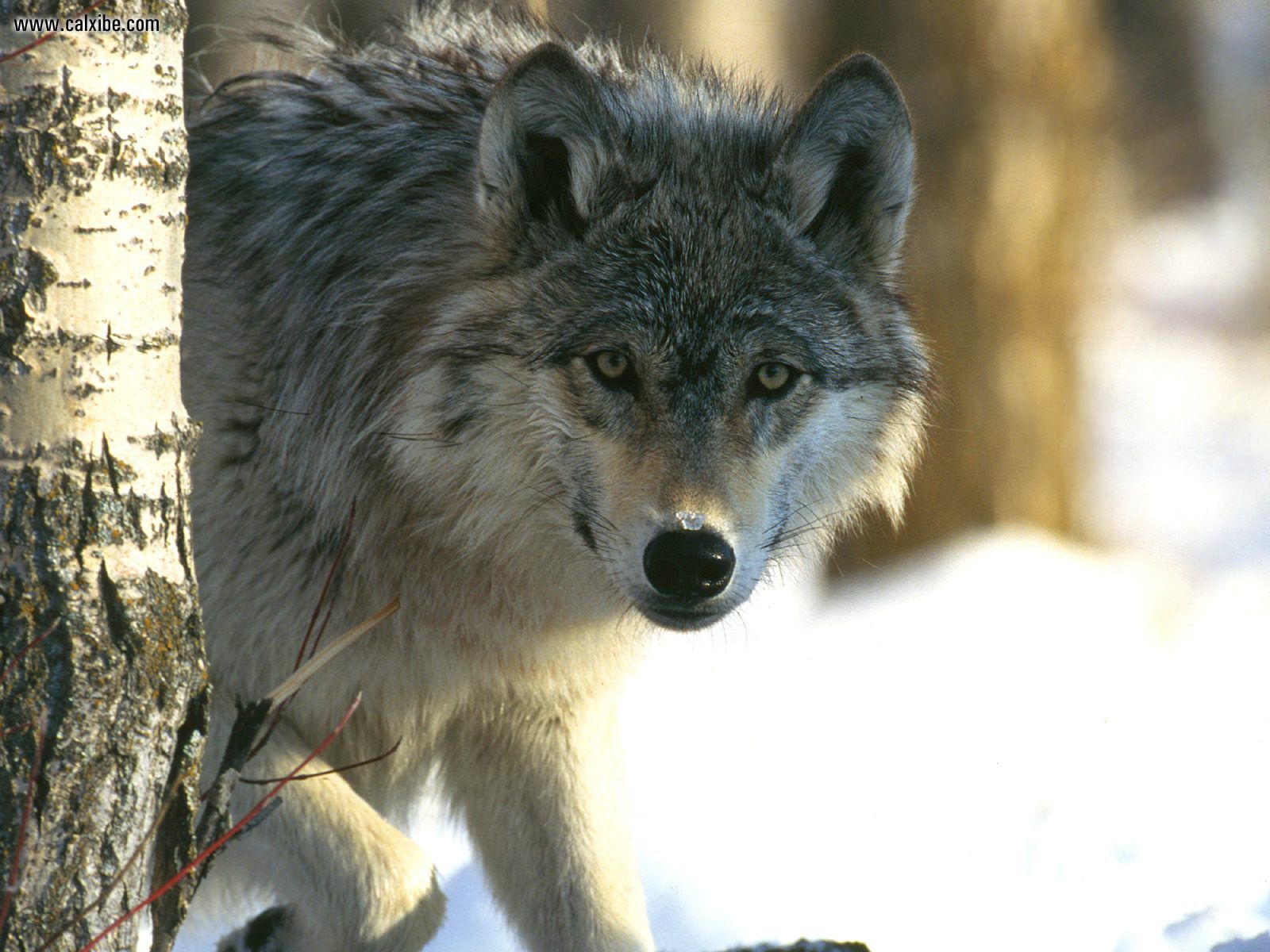
                             staring at you with heads lowered, ears erect,
                             paws spread wide and hackles half-raised,
                             golden eyes deciding whether you’re predator
                             or prey. What other category do they need?
                             What other thought? It’s you,

                             with your thousand and one concepts, who must
                             step back toward that joy-sap rising, step back
                             into the only world that is.


"Yesterday, on the familiar trail" by Marybeth Holleman. Text as published in Cirque: A Literary Journal for the North Pacific Rim (Vol. 1, No. 2, Summer Solstice, 2010). Presented here by poet submission. Check out Marybeth's blog, Art and Nature.

Art credit: "Grey Wolf," image by unknown photographer apparently at www.calxibe.com.