Showing posts with label Naomi Shihab Nye. Show all posts

Thursday, December 31, 2015

Naomi Shihab Nye: "Adios"


It is a good word, rolling off the tongue;
no matter what language you were born with
use it. Learn where it begins,
the small alphabet of departure,
how long it takes to think of it,
then say it, then be heard.

Marry it. More than any golden ring,
it shines, it shines.
Wear it on every finger
till your hands dance,
touching everything easily,
letting everything, easily, go.

Strap it to your back like wings.
Or a kite-tail. The stream of air behind a jet.
If you are known for anything,
let it be the way you rise out of sight
when your work is finished.

Think of things that linger: leaves,
cartons and napkins, the damp smell of mold.

Think of things that disappear.

Think of what you love best,
what brings tears into your eyes.

Something that said adios to you
before you knew what it meant
or how long it was for.

Explain little, the word explains itself.
Later perhaps. Lessons following lessons,
like silence following sound.


"Trying to Name What Doesn't Change" by Naomi Shihab Nye. Text as published in Words Under the Words: Selected Poems (Far Corner Books, 1995).  

Art credit: "Sir bird flies into the sunset" in Darwin, Australia, photograph by kevin kelly. 

Curator's note: After a three-year run, this project will conclude tomorrow with a special post. If you haven't already, I'd really appreciate your taking my brief survey regarding a possible anthology of mindfulness poetry.


Tuesday, March 31, 2015

Naomi Shihab Nye: "Trying to Name What Doesn't Change"


Roselva says the only thing that doesn’t change
is train tracks. She’s sure of it.
The train changes, or the weeds that grow up spidery   
by the side, but not the tracks.
I’ve watched one for three years, she says,
and it doesn’t curve, doesn’t break, doesn’t grow.

Peter isn’t sure. He saw an abandoned track
near Sabinas, Mexico, and says a track without a train   
is a changed track. The metal wasn’t shiny anymore.   
The wood was split and some of the ties were gone.

Every Tuesday on Morales Street
butchers crack the necks of a hundred hens.   
The widow in the tilted house
spices her soup with cinnamon.
Ask her what doesn’t change.

Stars explode.
The rose curls up as if there is fire in the petals.   
The cat who knew me is buried under the bush.

The train whistle still wails its ancient sound   
but when it goes away, shrinking back
from the walls of the brain,
it takes something different with it every time.


"Trying to Name What Doesn't Change" by Naomi Shihab Nye. Text as published in Words Under the Words: Selected Poems (Far Corner Books, 1995).

Art credit: Untitled image by unknown photographer.


Wednesday, December 3, 2014

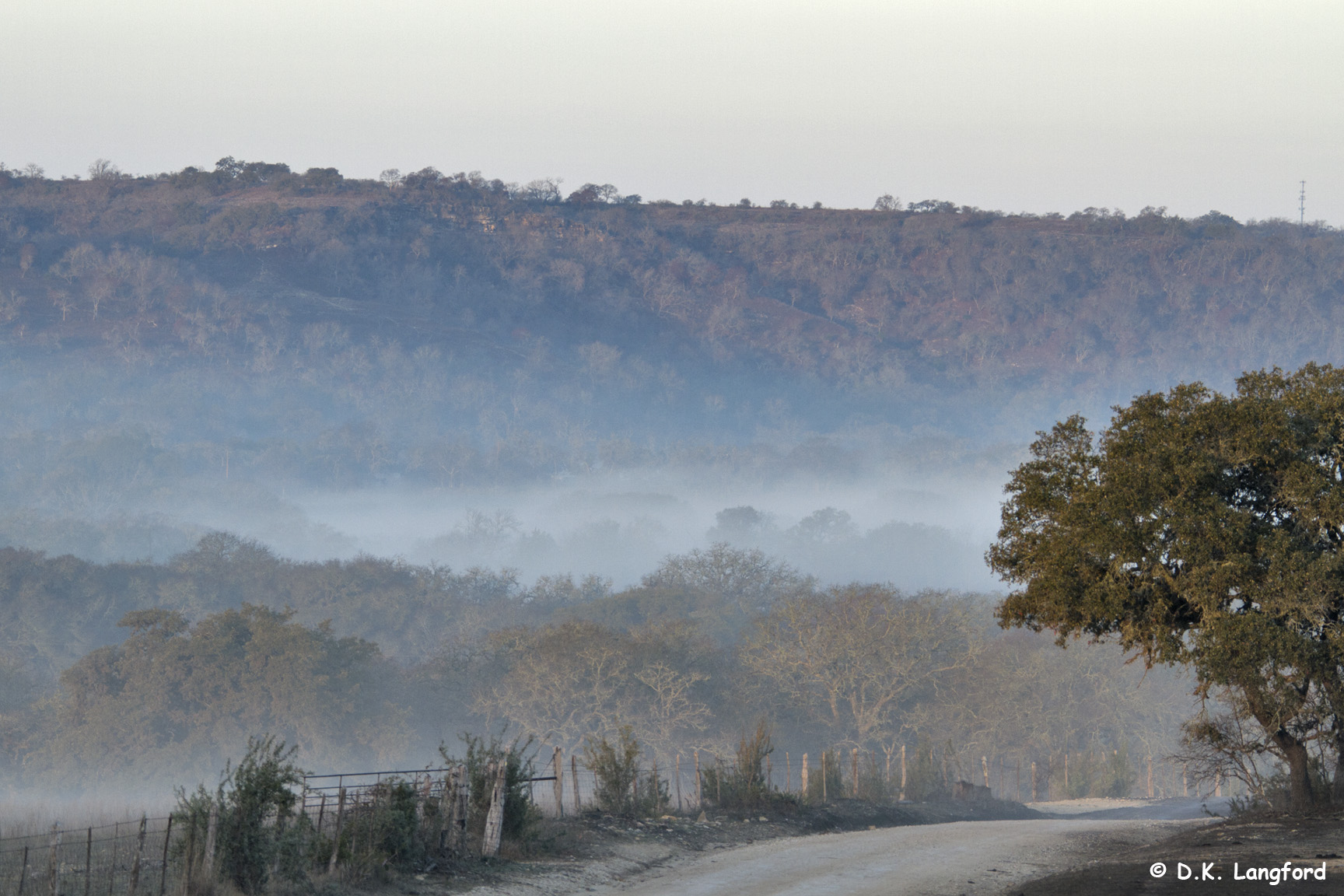
Naomi Shihab Nye: "At the Seven-Mile Ranch, Comstock, Texas"


I live like I know what I’m doing.

When I hand the horses a square of hay,
when I walk the road of stones
or chew on cactus pulp,
there’s a drumming behind me,
the day opens up to let me pass through.

I know the truth,
how always I’m following each small sign that appears.

This sheep that materialized behind a clump of cenizo bushes
knows I didn’t see him till he raised his head.

Out here it’s impossible to be lonely.
The land walking beside you is your oldest friend,
pleasantly silent, like already you’ve told the best stories
and each of you knows how much the other made up.


"At the Seven-Mile Ranch, Comstock, Texas" by Naomi Shihab Nye. Text as published in Hugging the Jukebox: Poems (E. P. Dutton, 1982).  

Art credit: "Giles Ranch Road [in Texas Hill Country] at dawn," photograph by D. K. Langford.


Friday, September 26, 2014

Naomi Shihab Nye: "Words When We Need Them"


                                             Before this early moment,
                                             another, ripe with rain,
                                             the scent of its own full shape.

                                             Each day the rooster
                                             we have never seen
                                             raises the first greeting
                                             and darkness which holds us
                                             in its loose pocket all night
                                             sets us down.

                                             Now we walk,
                                             waking up rooms,
                                             switching on lights.

                                             Into the breath,
                                             wordless but ripe
                                             with all possible words,
                                             messages not yet gathered
                                             or sent.

                                             Morning looms,
                                             more friend than
                                             the best friend.

                                             We could still say.


"Words When We Need Them" by Naomi Shihab Nye, from Red Suitcase: Poems. © BOA Editions Ltd., 1994.  

Art credit: Untitled image by unknown photographer (originally black and white).


Tuesday, July 15, 2014

Naomi Shihab Nye: "Daily"


These shriveled seeds we plant,
corn kernel, dried bean,
poke into loosened soil,
cover over with measured fingertips
 
These T-shirts we fold into
perfect white squares
 
These tortillas we slice and fry to crisp strips
This rich egg scrambled in a gray clay bowl
 
This bed whose covers I straighten
smoothing edges till blue quilt fits brown blanket
and nothing hangs out

This envelope I address
so the name balances like a cloud
in the center of sky
 
This page I type and retype
This table I dust till the scarred wood shines
This bundle of clothes I wash and hang and wash again
like flags we share, a country so close
no one needs to name it
 
The days are nouns: touch them
The hands are churches that worship the world


"Daily" by Naomi Shihab Nye, from The Words Under the Words: Selected Poems. © Eighth Mountain Press, 1994.  

Art credit: Detail from photograph of crispy tortilla chips, likely by

Thursday, June 5, 2014

Naomi Shihab Nye: "Missing the Boat"


It is not so much that the boat passed
and you failed to notice it.
It is more like the boat stopping
directly outside your bedroom window,
the captain blowing the signal-horn,
the band playing a rousing march.

The boat shouted, waving bright flags,
its silver hull blinding in the sunlight.

But you had this idea you were going by train.

You kept checking the time-table,
digging for tracks.

And the boat got tired of you,
so tired it pulled up the anchor
and raised the ramp.

The boat bobbed into the distance,
shrinking like a toy—
at which point you probably realized
you had always loved the sea.


"Missing the Boat" by Naomi Shihab Nye, from Different Ways to Pray: Poems. © Breitenbush Publications, 1980.

Art credit: "Cwch ar y Gorwel / Boat on Horizon," by Dylan Arnold (originally color). Note: The image has since been removed at the request of the artist.


Thursday, March 27, 2014

Naomi Shihab Nye: "Gate A-4" [Prose Poem]


Wandering around the Albuquerque Airport Terminal, after learning
my flight had been delayed four hours, I heard an announcement:
"If anyone in the vicinity of Gate A-4 understands any Arabic, please
come to the gate immediately."

Well—one pauses these days. Gate A-4 was my own gate. I went there.

An older woman in full traditional Palestinian embroidered dress, just
like my grandma wore, was crumpled to the floor, wailing loudly. "Help,"
said the flight service person. "Talk to her. What is her problem? We
told her the flight was going to be late and she did this."

I stooped to put my arm around the woman and spoke to her haltingly.
"Shu-dow-a, Shu-bid-uck Habibti? Stani schway, Min fadlick, Shu-bit-
se-wee?" The minute she heard any words she knew, however poorly
used, she stopped crying. She thought the flight had been cancelled
entirely. She needed to be in El Paso for major medical treatment the
next day. I said, "No, we're fine, you'll get there, just later, who is
picking you up? Let's call him."

We called her son and I spoke with him in English. I told him I would
stay with his mother till we got on the plane and would ride next to
her—Southwest. She talked to him. Then we called her other sons just
for the fun of it. Then we called my dad and he and she spoke for a
while in Arabic and found out of course they had ten shared friends. Then I
thought just for the heck of it why not call some Palestinian poets I know
and let them chat with her? This all took up about two hours.

She was laughing a lot by then. Telling about her life, patting my knee,
answering questions. She had pulled a sack of homemade mamool
cookies—little powdered sugar crumbly mounds stuffed with dates and
nuts—out of her bag—and was offering them to all the women at the gate.
To my amazement, not a single woman declined one. It was like a
sacrament. The traveler from Argentina, the mom from California, the
lovely woman from Laredo—we were all covered with the same powdered
sugar. And smiling. There is no better cookie.

And then the airline broke out free beverages from huge coolers and two
little girls from our flight ran around serving us all apple juice and they
were covered with powdered sugar, too. And I noticed my new best friend—
by now we were holding hands—had a potted plant poking out of her bag,
some medicinal thing, with green furry leaves. Such an old country tradi-
tion. Always carry a plant. Always stay rooted to somewhere.

And I looked around that gate of late and weary ones and I thought, This
is the world I want to live in. The shared world. Not a single person in that
gate—once the crying of confusion stopped—seemed apprehensive about
any other person. They took the cookies. I wanted to hug all those other
women, too.

This can still happen anywhere. Not everything is lost.


"Gate A-4" [Prose Poem] by Naomi Shihab Nye, from Honey Bee: Poems & Short Prose. © Greenwillow Books, 2008.

Photography credit: "Date Filled Cookies or Ma'amoul," by Sanjeeta KK, who provides a recipe on her blog (originally color).


Wednesday, December 4, 2013

Naomi Shihab Nye: "Kindness"


Before you know what kindness really is
you must lose things,
feel the future dissolve in a moment
like salt in a weakened broth.
What you held in your hand,
what you counted and carefully saved,
all this must go so you know
how desolate the landscape can be
between the regions of kindness.
How you ride and ride
thinking the bus will never stop,
the passengers eating maize and chicken
will stare out the window forever.

Before you learn the tender gravity of kindness,
you must travel where the Indian in a white poncho
lies dead by the side of the road.
You must see how this could be you,
how he too was someone
who journeyed through the night
with plans and the simple breath
that kept him alive.

Before you know kindness
as the deepest thing inside,
you must know sorrow
as the other deepest thing.
You must wake up with sorrow.
You must speak to it till your voice
catches the thread of all sorrows
and you see the size of the cloth.
Then it is only kindness
that makes sense anymore,
only kindness that ties your shoes
and sends you out into the day
to mail letters and purchase bread,
only kindness that raises its head
from the crowd of the world to say
it is I you have been looking for,
and then goes with you every where
like a shadow or a friend


"Kindness" by Naomi Shihab Nye, from The Words Under the Words: Selected Poems. © Eighth Mountain Press, 1995.

Photography credit: "A monk prays for a dead man in the station hall of the Shanxi Taiyuan Train Station in Shanxi, China, November 25, 2011," by REUTERS/Asianewsphoto (originally color).


Thursday, November 14, 2013

Naomi Shihab Nye: "Sifter"


When our English teacher gave
our first writing invitation of the year,
Become a kitchen implement
in 2 descriptive paragraphs, I did not think
butcher knife or frying pan,
I thought immediately
of soft flour showering throught the little holes
of the sifter and the sifter’s pleasing circular
swishing sound, and wrote it down. 
Rhoda became a teaspoon,
Roberto a funnel,
Jim a muffin tin
and Forrest a soup pot. 
We read our paragraphs out loud.
Abby was a blender.  Everyone laughed
and acted but the more we thought about it,
we were all everything in the whole kitchen,
drawers and drainers,
singing teapot and grapefruit spoon
with serrated edges, we were all the
empty cup, the tray. 
This, said our teacher, is the beauty of metaphor.
It opens doors.
What I could not know then
was how being a sifter
would help me all year long.
When bad days came
I would close my eyes and feel them passing
through the tiny holes.
When good days came
I would try to contain them gently
the way flour remains
in the sifter until you turn the handle.
Time, time.  I was a sweet sifter in time
and no one ever knew.


"Sifter" by Naomi Shihab Nye, from A Maze Me: Poems for Girls. © Greenwillow Books, 2005.  

Photography credit: "A person sifting bromated flour," found at this link (originally color).


Sunday, September 29, 2013

Naomi Shihab Nye: "Breaking the Fast"


1.

Japanese teacher says:
At first light, rise.
Don’t hover between
sleep and waking,
this makes you heavy,
puts a stone inside your heart.

The minute you drift back to shore,
anchor. Breathe.
Remember your deepest name.

2.

Sometimes objects stun me,
bamboo strainer, gray mug,
sitting exactly where
they were left.

They have not slept
or dreamt of lost faces.

I touch them carefully,
saying, tell me what you know.

3.

Cup of waves,
strawberry balanced
in a seashell.

In morning the water seems
clear to the bottom.

No fish blocks my view.


"Breaking the Fast" by Naomi Shihab Nye, from Red Suitcase. © BOA Editions, 1994.

Image credit: "Waking Up," acrylic on canvas, by Douglas Simonson (originally color).


Sunday, June 23, 2013

Naomi Shihab Nye: "The Tray"


Even on a sorrowing day
the little white cups without handles
would appear
filled with steaming hot tea
in a circle on the tray,
and whatever we were able
to say or not say,
the tray would be passed,
we would sip
in silence,
it was another way
lips could be speaking together,
opening on the hot rim,
swallowing in unison.


"The Tray" by Naomi Shihab Nye, from 19 Varieties of Gazelle. © Greenwillow Books, 2002.

Photography credit: "Little white cups, a tray, and a textured porcelain pitcher," by Laurie Goldstein (originally color).


Monday, March 25, 2013

Naomi Shihab Nye: "Observer"


I watch how other things travel
to get an idea how I might move.
A cloud sweeps by silently,
gathering other clouds.
A doodlebug curls in his effort to get there.
A horse snorts before stepping forward.
A caterpillar inches across the kitchen floor.
When I carry him outside on a leaf,
I imagine someone doing that to me.
Would I scream?
In the heart of the day
nothing moves.
No one is going anywhere
or coming back.
The blue glass on the table
lets light pass through.
Something shines
but nothing moves.
I watch that too.


"Observer" by Naomi Shihab Nye. No other bibliographic information available. 

Photography credit: Unknown (originally color).


Thursday, March 7, 2013

Naomi Shihab Nye: "The Traveling Onion"


It is believed that the onion originally came from India. In Egypt it was an object of worship––why I haven't been able to find out. From Egypt the onion entered Greece and on to Italy, thence into all of Europe. –– Better Living Cookbook


When I think how far the onion has traveled
just to enter my stew today, I could kneel and praise
all small forgotten miracles,
crackly paper peeling on the drainboard,
pearly layers in smooth agreement,
the way knife enters onion
and onion falls apart on the chopping block,
a history revealed.

And I would never scold the onion
for causing tears.
It is right that tears fall
for something small and forgotten.
How at meal, we sit to eat,
commenting on texture of meat or herbal aroma
but never on the translucence of onion,
now limp, now divided,
or its traditionally honorable career:
For the sake of others,
disappear.


"The Traveling Onion" by Naomi Shihab Nye, from Contemporary American Poems, edited by Kay Ryan. © People's Literature Publishing House, 2011.  

Photograph: "Slice of Red Onion," by unnamed blogger at  http://www.mybeautfulthings.wordpress.com/ (originally color and horizontal).


Friday, January 11, 2013

Naomi Shihab Nye: "Fresh"


To move
cleanly.
Needing to be
nowhere else.
Wanting nothing
from any store.
To lift something
you already had
and set it down in
a new place.
Awakened eye
seeing freshly.
What does that do to
the old blood moving through
its channels?


"Fresh" by Naomi Shihab Nye, from You & Yours. © BOA Editions, 2005.

Photograph: " 'Simple' Still Life," by Mark Longo (originally in color).