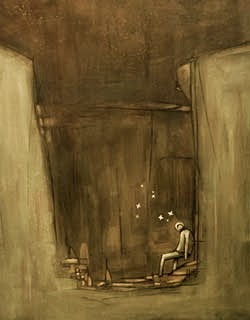
Monday, February 3, 2014

Linda Pastan: "In This Season of Waiting"


Under certain conditions,
when the moon in the western sky
seems frozen there, for instance

even as the sun is rising in the east,
so that soon two sides of the coin
will be facing each other;

or when the snow
which is a stranger here
fills our trees with its cold flowers;

when the single
bluejay at the feeder
is so still

it could be enameled there,
then the earth becomes an emblem
for whatever we believe.


"In This Season of Waiting" by Linda Pastan, from Heroes in Disguise. © W. W. Norton and Company, 1991.  

Photography credit: "Why the Sun Follows the Moon," by Native American Encyclopedia (originally color).


Sunday, February 2, 2014

Samuel Menashe: "Now"


                                   There is never an end to loss, or hope
                                   I give up the ghost for which I grope
                                   Over and over again saying Amen
                                   To all that does or does not happen—
                                   The eternal event is now, not when


"Now" by Samuel Menashe, from Samuel Menashe: New and Selected Poems, Expanded Edition. © Library of Congress, 2005.

Photography credit: by Martin Duffy, a friend of Menashe, who writes of this image: "In the summer of 2000 Sam was again spending time in Ireland during his 75th year.... we took a walk one evening along a strand. Sam halted with a piece of wood and wrote a poem of his in the sand:
Pity us
By the sea
On the sands
So briefly
"As he was doing this, I took a photograph. When I sent him photographs of his holiday with me, he singled out this photograph as the one that 'defined' him in his 75th year."


Saturday, February 1, 2014

Jane Hirshfield: "The Promise"


Mysteriously they entered, those few minutes.
Mysteriously, they left.
As if the great dog of confusion guarding my heart,
who is always sleepless, suddenly slept.
It was not any awakening of the large, not so much as that,
only a stepping back from the petty.
I gazed at the range of blue mountains,
I drank from the stream. Tossed in a small stone from the bank.
Whatever direction the fates of my life might travel, I trusted.
Even the greedy direction, even the grieving, trusted.
There was nothing left to be saved from, bliss nor danger.
The dog's tail wagged a little in his dream.


"The Promise" by Jane Hirshfield, from After: Poems. © HarperCollins Publishers, 2005.

Photography credit: Untitled image by unknown photographer, found at this link (originally color).

Friday, January 31, 2014

Barbara Crooker: "Ordinary Life"


This was a day when nothing happened,
the children went off to school
without a murmur, remembering
their books, lunches, gloves.
All morning, the baby and I built block stacks
in the squares of light on the floor.
And lunch blended into naptime,
I cleaned out kitchen cupboards,
one of those jobs that never gets done,
then sat in a circle of sunlight
and drank ginger tea,
watched the birds at the feeder
jostle over lunch's little scraps.
A pheasant strutted from the hedgerow,
preened and flashed his jeweled head.
Now a chicken roasts in the pan,
and the children return,
the murmur of their stories dappling the air.
I peel carrots and potatoes without paring my thumb.
We listen together for your wheels on the drive.
Grace before bread.
And at the table, actual conversation,
no bickering or pokes.
And then, the drift into homework.
The baby goes to his cars, drives them
along the sofa's ridges and hills.
Leaning by the counter, we steal a long slow kiss,
tasting of coffee and cream.
The chicken's diminished to skin & skeleton,
the moon to a comma, a sliver of white,
but this has been a day of grace
in the dead of winter,
the hard cold knuckle of the year,
a day that unwrapped itself
like an unexpected gift,
and the stars turn on,
order themselves
into the winter night.


"Ordinary Life" by Barbara Crooker, from Ordinary Life. © ByLine Press, 2001.  

Image credit: "Stacked," oil on panel, by James Neil Hollingsworth (originally color).


Thursday, January 30, 2014

Hafiz: "The Sun in Drag"


You are the sun in drag.
You are God hiding from yourself.
Remove all the “mine”—that is the veil.
Why ever worry about
Anything?
Listen to what your friend Hafiz
Knows for certain:
The appearance of this world
Is a Magi’s brilliant trick, though its affairs are
Nothing into nothing.
You are a divine elephant with amnesia
Trying to live in an ant
Hole.
Sweetheart, O sweetheart
You are God in
Drag!


"The Sun in Drag" by Hafiz, from The Gift: Poems of Hafiz, the Great Sufi Master. Purported to be translated from the original Persian (Farsi) by Daniel Ladinsky. © Penguin Compass, 1999.

Please note that Ladinsky's "translations" are controversial, considered by many to be less Hafiz than Ladinsky himself. 

Photography credit: "Hidden Sun," by biglaur (originally color).


Wednesday, January 29, 2014

Czeslaw Milosz: "Faith"


The word Faith means when someone sees
A dew-drop or a floating leaf, and knows
That they are, because they have to be.
And even if you dreamed, or closed your eyes
And wished, the world would still be what it was,
And the leaf would still be carried down the river.

It means that when someone’s foot is hurt
By a sharp rock, he also knows that rocks
Are here so they can hurt our feet.
Look, see the long shadow cast by the trees;
And flowers and people throw shadows on the earth:
What has no shadow has no strength to live. 


"Faith" by Czeslaw Milosz, from The Separate Notebooks: Poems. Translated from the Polish by Renata Gorczynski, Robert Hass, and Robert Pinsky. © Ecco Press, 1984.

Photography credit: "Fall Floating Downstream," by Daniel Johnson (originally color).


Tuesday, January 28, 2014

Saadi Youssef: "Attention"


                                    Those who come by me passing
                                    I will remember them,
                                    and those who come heavy and overbearing
                                    I will forget.

                                    This is why
                                    when air gushes between mountains
                                    we describe the wind
                                    and forget the rocks.


"Attention" by Saadi Youssef. Translated from the Arabic by Khaled Mattawa. Published in Paris Review (Spring 2000).

Photography credit: Untitled image by unknown photographer, found at this link (originally color).


Monday, January 27, 2014

Portia Nelson: "Autobiography in Five Short Chapters"


Chapter One
                                   I walk down the street.
                                              There is a deep hole in the sidewalk.
                                              I fall in.
                                              I am lost.... I am helpless.
                                                        It isn't my fault.
                                   It takes forever to find a way out.


Chapter Two
                                   I walk down the same street.
                                              There is a deep hole in the sidewalk.
                                              I pretend I don't see it.
                                              I fall in again.
                                   I can't believe I am in the same place.
                                                       But, it isn't my fault.
                                   It still takes a long time to get out.


Chapter Three
                                   I walk down the same street.
                                              There is a deep hole in the sidewalk.
                                              I see it is there.
                                              I still fall in ... it's a habit ... but,
                                                       my eyes are open.
                                                       I know where I am.
                                   It is my fault.
                                   I get out immediately.


Chapter Four
                                   I walk down the same street.
                                              There is a deep hole in the sidewalk.
                                              I walk around it.


Chapter Five
                                   I walk down another street.


"Autobiography in Five Short Chapters" by Portia Nelson, from There's a Hole in My Sidewalk: The Romance of Self-Discovery. © Atria Books/Beyond Words, 2012.

Image credit: Untitled image by unknown artist, found at this link (originally color).


Sunday, January 26, 2014

Stephen Levine: "Half Life"


We walk through half our life
as if it were a fever dream
barely touching the ground
our eyes half open
our heart half closed.

Not half knowing who we are
we watch the ghost of us drift
from room to room
through friends and lovers
never quite as real as advertised.

Not saying half we mean
or meaning half we say
we dream ourselves
from birth to birth
seeking some true self.

Until the fever breaks
and the heart can not abide
a moment longer
as the rest of us awakens,
summoned from the dream,
not half caring for anything but love.


"Half Life" by Stephen Levine, from Breaking the Drought: Visions of Grace. © Larson Publications, 2007.

Image credit: Detail from untitled abstract painting by Jean Theobald Jacus, 1924 (originally color).


Saturday, January 25, 2014

Janine Pommy Vega: "Which Side Are You On?"


Where does my anger come from
            at the laziness, the prosaic?
How many times will you enter a room
          and leave it vacant: in and out,
in and out, visiting a temple of possibility
           and never leave a gift on the altar?

Come down to the river of your own soul, we are    
           excavating 
here, the yellow helmets you see are so many
suns on the horizon, going down and coming up
in no particular time sequence or order.
         When one flower opens, Kabir says,
                       ordinarily
dozens open. I'm digressing.

Every time you visit yourself without
             respect, you lose. Without love,
Also.
Read the coins you've thrown down into the dirt,
          they spell integrity. You recall those
early moments in
your young life when you sang. And we were
             witnesses—if not then, now. We can
             see you
outside the ordinary, grab onto a miracle and
understand it was no more you than the
            wind.

Oh, so that's it, finally:
No more you or me than that mountain
         there. And no mountain either.

                   Which side are you on?

                                       Eastern C.F., Napanoch, NY,
                                       June 6, 1996


"Which Side Are You On?" by Janine Pommy Vega, from Mad Dogs of Trieste: New & Selected Poems. © David R. Godine Publisher, 2000.

Photography credit: "Wreckage around Keansburg Amusement Park, NJ due to Superstorm Sandy," by © Logan Mock-Bunting, 2012 (originally color).


Friday, January 24, 2014

Nina Corwin: "What Morning Looks Like"


Another dawn poem. A virgin Thursday
morning that sparkles and blushes before
falling to the spatterings of day.

I'm starting a journey, dragging my suitcase
and carry-on bags to the taxi stand
at the corner. It's an hour before the earliest

alarm I know. Before the street lights shut down
at the tired end of their shift; when the air bites
crisp and clean. Before the turbulent machine of day

accelerates into full throttle. An orange cab
pulls up, driver devout as desert sand,
serenity riding in the passenger seat.

I slide into the back, give my destination.
He glances at my face in the rear view mirror.
I can see only his eyes, the dark oasis

of them. It seems as if we're sharing
a secret, though we are not. Red streaks
begin to reach along the horizon.

Obviously he and dawn are old acquaintances
having peered into each other's blinking,
bloodshot eyes a time or two. Can't remember

the last time I was out at this hour, I say
reaching for conversation. I ask him what time
his day starts and he tells me 4 a.m.

So then I ask what 4 a.m. looks like and he says:
It looks like anything else. It looks like God.
He accelerates easily. An occasional car rolls toward us.

Headlights nod as they pass.


"What Morning Looks Like" by Nina Corwin. Published online at the e-poets network (date unknown), where the poem is said to have first appeared in Flyway.  

Photography credit: Detail from "Close Up of a Taxi Driver's Eyes in Rearview Mirror of His Cab," by Jim Richardson (originally color).


Thursday, January 23, 2014

Nura Yingling: "Step Six and Step Seven"


Let me be where I am.
Let this bread, this morning, be their own ceremony.
Let me pass the gilt mirrors without looking.

When the lead mouth of fear clamps onto mine
and blasts her wind of rope and iron filings into me,
let my breath be forgiveness returned for her black sadness.

Let poems be cups of praying
made for holding silence.


"Step Six and Step Seven" by Nura Yingling, from for Holding Silence. © BlazeVOX, 2013.  

Image credit: "Hovis Bread and Knife," painting by Alan Gwynne-Jones, 1945 (originally color).


Wednesday, January 22, 2014

D. H. Lawrence: "Maximus"


God is older than the sun and moon
and the eye cannot behold him
nor voice describe him.

But a naked man, a stranger, leaned on the gate
with his cloak over his arm, waiting to be asked in.
So I called him: Come in, if you will!––
He came in slowly, and sat down by the hearth.
I said to him: And what is your name?––
He looked at me without answer, but such a loveliness
entered me, I smiled to myself, saying: He is a God!
So he said: Hermes!

God is older than the sun and moon
and the eye cannot behold him
nor the voice describe him:
and still, this is the God Hermes, sitting by my hearth.


"Maximus" by D. H. Lawrence, from The Complete Poems of D. H. Lawrence. © Wordsworth Editions, 1994.

Image credit: "Hermes," oil on canvas, by Salvador Dali, 1981 (originally color).


Tuesday, January 21, 2014

Izumi Shikibu: Untitled ["Although the Wind"]


                                                  Although the wind
                                                  blows terribly here,
                                                  the moonlight also leaks
                                                  between the roof planks
                                                  of this ruined house.


Untitled ["Although the Wind"] by Izumi Shikibu, from The Ink Dark Moon: Love Poems by Onono Komachi and Izumi Shikibu, Women of the Ancient Court of Japan, edited and translated from the Japanese by Jane Hirshfield with Mariko Aratani. © Vintage Classics, 1990.

Photography credit: Untitled image by Lexie in NZ (originally color).


Monday, January 20, 2014

Edgar Lee Masters: "111. Ernest Hyde"


My mind was a mirror:
It saw what it saw, it knew what it knew.
In youth my mind was just a mirror
In a rapidly flying car,
Which catches and loses bits of the landscape.
Then in time
Great scratches were made on the mirror,
Letting the outside world come in,
And letting my inner self look out.
For this is the birth of the soul in sorrow,
A birth with gains and losses.
The mind sees the world as a thing apart,
And the soul makes the world at one with itself.
A mirror scratched reflects no image—
And this is the silence of wisdom.


"111. Ernest Hyde" by Edgar Lee Masters, from Spoon River Anthology. © The Macmillan Company, 1916.  

Photography credit: "Scratched Mirror," by Chris Schmalz (originally color).


Sunday, January 19, 2014

Laura Davies Foley: "The Offering"


These woods
on the edges of a lake
are settling now
to winter darkness.
Whatever was going to die
is gone—
crickets, ferns, swampgrass.
Bare earth fills long spaces of a field.
But look:
a single oak leaf
brown and shining
like a leather purse.
See what it so delicately offers
lying upturned on the path.
See how it reflects in its opened palm
a cup of deep, unending sky.


"The Offering" by Laura Davies Foley. © Laura Davies Foley. Published here via poet submission.

Photography credit: "Leaf on the Water," by Noemy009 (originally color).   


Saturday, January 18, 2014

Bertolt Brecht: "Everything Changes"


Everything changes. You can make
A fresh start with your final breath.
But what has happened has happened. And the water
You once poured into the wine cannot be
Drained off again.

What has happened has happened. The water
You once poured into the wine cannot be
Drained off again, but
Everything changes. You can make
A fresh start with your final breath.


"Everything Changes" by Bertolt Brecht, from Poetry and Prose. © Continuum, 2003.

Image credit: "Warli Painting about Life Cycle," clay on cotton fabric, by unknown artist, found at this link (originally color).


Friday, January 17, 2014

Dana Gioia: "Entrance"


Whoever you are: step out of doors tonight,
Out of the room that lets you feel secure.
Infinity is open to your sight.
Whoever you are.
With eyes that have forgotten how to see
From viewing things already too well-known,
Lift up into the dark a huge, black tree
And put it in the heavens: tall, alone.
And you have made the world and all you see.
It ripens like the words still in your mouth.
And when at last you comprehend its truth,
Then close your eyes and gently set it free.


(After Rilke)


"Entrance" by Dana Gioia, from Interrogations at Noon: Poems. © Graywolf Press, 2001.

Photography credit: Detail from "Angel Oak Tree," by Amy Tyler Photography (originally black and white).


Thursday, January 16, 2014

Suheir Hammad: "talisman"


it is written
the act of writing is
holy words are
sacred and your breath
brings out the
god in them
i write these words
quickly repeat them
softly to myself
this talisman for you
fold this prayer
around your neck fortify
your back with these
whispers
may you walk ever
loved and in love
know the sun
for warmth the moon
for direction
may these words always
remind you your breath
is sacred words
bring out the god
in you


"talisman" by Suheir Hammad. Published online by TheScreamOnline.com (date unknown).

Image credit: "Amulet, 11th century, Fatimid, Egypt," ink on paper (originally color). Note from source: "Centuries before block printing was introduced in Europe, the technique was used in the Islamic world to produce miniature texts consisting of prayers, incantations, and Qur’anic verses that were kept in amulet boxes. The text on this amulet is in the angular kufic script. The six-pointed star, a familiar symbol in Islamic art, is usually called `Solomon's seal.'"


Wednesday, January 15, 2014

David Whyte: "The Winter of Listening"


No one but me by the fire,
my hands burning
red in the palms while
the night wind carries
everything away outside.

All this petty worry
while the great cloak
of the sky grows dark
and intense
round every living thing.

What is precious
inside us does not
care to be known
by the mind
in ways that diminish
its presence.

What we strive for
in perfection
is not what turns us
into the lit angel
we desire,

what disturbs
and then nourishes
has everything
we need.

What we hate
in ourselves
is what we cannot know
in ourselves but
what is true to the pattern
does not need
to be explained.

Inside everyone
is a great shout of joy
waiting to be born.

Even with the summer
so far off
I feel it grown in me
now and ready
to arrive in the world.

All those years
listening to those
who had
nothing to say.

All those years
forgetting
how everything
has its own voice
to make
itself heard.

All those years
forgetting
how easily
you can belong
to everything
simply by listening.

And the slow
difficulty
of remembering
how everything
is born from
an opposite
and miraculous
otherness.

Silence and winter
has led me to that
otherness.

So let this winter
of listening
be enough
for the new life
I must call my own.


"The Winter of Listening" by David Whyte, from The House of Belonging. © Many Rivers Press, 1997.

Photography credit: Detail from "Seeking Warmth: A Kashmiri man warmed his hands over a fire on a street on a cold morning in Srinagar, India, Wednesday," by Fayaz Kabli/Reuters (originally color).